The Land of White Gold brings together at the Museo Gaiás more than 160 pieces from up to 28 museums and institutions across Spain, Portugal, Denmark, and the United Kingdom. The exhibition will open to the public on the afternoon of Friday 20 November on the second floor of the Museo Centro Gaiás.
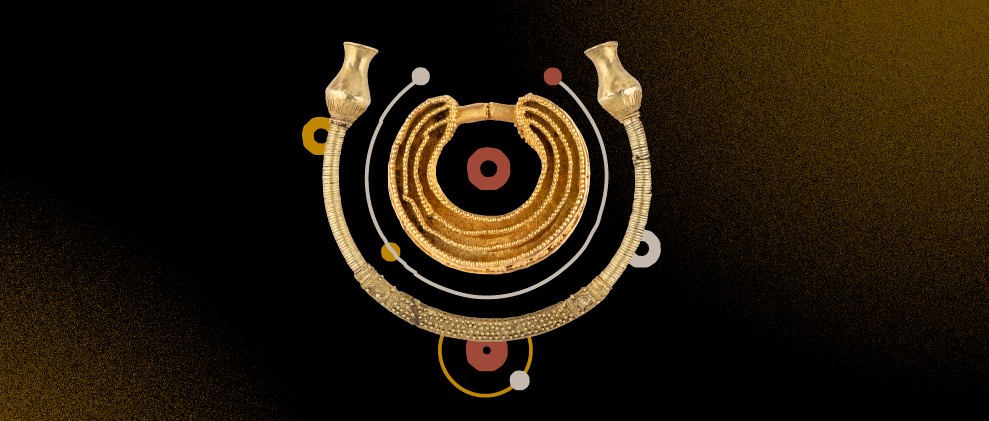
The exhibition displays torcs and other pre-Roman jewellery—such as diadems, earrings, bracelets, and hair rings—along with sculptures, tools, and objects related to goldworking. Accompanied by audiovisuals, illustrations, and an innovative archaeoplanetarium, they allow visitors to explore both the technology and the social and ritual uses of ancient gold.
This will be the first opportunity in Spain to see the two Ourense torcs and the remarkable Sintra torc from the British Museum collection, alongside a replica of the extraordinary Danish Gundestrup cauldron, which links Gallaecian symbolism with Northern Europe. Also on public display for the first time are the previously unseen Bergondo torcs, discovered on a private estate in 2023.
White gold—so named by the Greek geographer Strabo due to the high silver content alloyed with the metal—was once an abundant resource across the territories spanning Galicia, northern Portugal down to the Douro River, Asturias, and western Castile and León. Its use in these societies dates back 4,500 years to the earliest stages of prehistoric metallurgy, evolving up until their contact with Rome.
The Shimmer That Speaks to Us
Curated by Xosé-Lois Armada, director of the Institute of Heritage Sciences (INCIPIT-CSIC), and backed by the most cutting-edge archaeological research of recent years, the exhibition traces the evolution of ancient goldwork and its enduring influence today.
Prehistoric motifs such as spirals and triskelions have become emblems of identity and a source of inspiration for contemporary artisans, while chance discoveries and the search for Gallaecian treasures have also given rise to numerous legends and oral traditions.
Connecting with the Past Through the Sky: The Archaeoplanetarium
The Land of White Gold pioneers the integration of technology through an archaeoplanetarium installation that recreates the relationship between past astronomical events and the locations of some of Europe’s most significant ancient goldwork hoards, such as the Caldas de Reis treasure, the Leiro helmet, and the Moñes diadem.
Using photographs and digital models, the archaeoplanetarium displays panoramic, wraparound views of built environments, landscapes, and the night sky, creating realistic and immersive observation simulations.
This installation—a first in Europe and unprecedented in archaeological exhibitions to date—bridges past and present, exploring the vital role that celestial bodies, particularly the sun, played in shaping the myths and rhythms of life in antiquity.